


Every few weeks we get a call that starts the same way. Someone ran a raffle on a tool that promised to be free. The fundraiser closed. They did the math. And the number they raised was a lot smaller than the number they sold.
Sometimes they lost 30% of would-be buyers at checkout because the tool hit supporters with a 22% tip prompt at the end. Sometimes they chose a raffle site that only works with Stripe. And then tried to raffle a bottle of bourbon or an antique firearm and got their account suspended mid-campaign. Sometimes the tool just didn’t work for basket raffles or Queen of Hearts, so they ran the whole thing on a spreadsheet and prayed.
We’ve been answering these calls for approximately 20 years. That’s not a marketing line. Chance2Win built the first online raffle website before most of today’s fundraising tools existed. We didn’t add raffles to a donation tool. We built raffle infrastructure from scratch. The difference shows.
Here’s what actually separates a good charity raffle website from one that quietly costs your organization money.
1. It Has to Support the Raffle Type You Actually Want to Run
This sounds obvious. It isn’t. Most tools support one thing: a simple online raffle where someone buys a ticket and gets entered in a drawing. That covers maybe 40% of what nonprofits actually run.
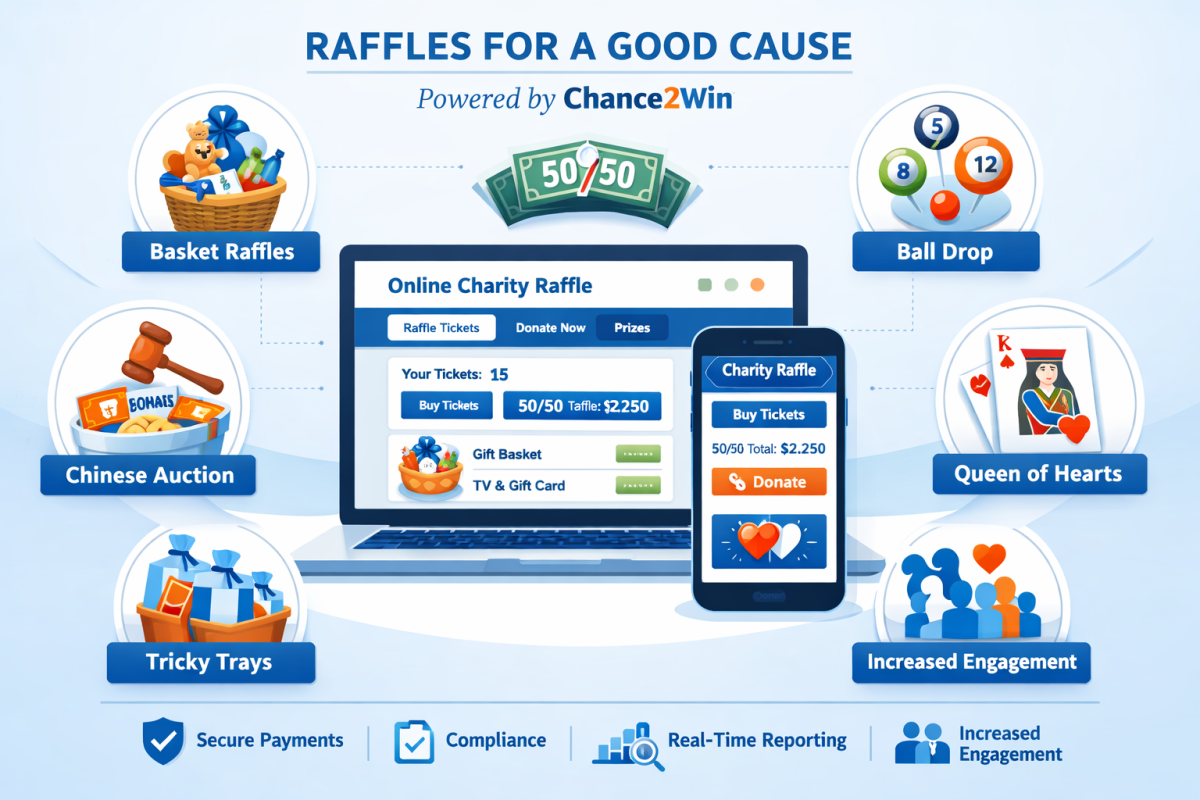
The other 60%, including basket raffles, Queen of Hearts progressives, duck races, ball drops, and 50/50 splits, require fundamentally different infrastructure. Basket raffles need per-basket ticket pools with buyer balances tracked separately per item. Queen of Hearts needs card-selection logic, weekly progression, and jackpot accumulation. Duck races need pre-numbered pools that sell down in real time.
Chance2Win supports all of them. Not as workarounds. As first-class features built over two decades of running real fundraisers.
Raffle types we support:
- Traditional online raffles: ticket sales, digital drawing, winner notification
- Basket raffles / tricky trays / Chinese auctions: multi-pool allocation, per-buyer ticket balance per basket
- Queen of Hearts: card selection, progressive jackpot, weekly draws
- 50/50 raffles: split-pot display, live running total
- Ball drops and duck races: pre-numbered pool, real-time sell-down
- Hybrid raffles: cash, check, and online entries in one unified drawing pool
For a full breakdown of how each type works and which format fits which audience, see our Types of Nonprofit Raffles Explained.
Not sure how the options stack up? Check out Chance2Win vs. RallyUp for a side-by-side look at features and real-world raffle support.
2. Cash and Check Buyers Need to Be in the Drawing Too
This one surprises people. Every nonprofit runs at least some portion of ticket sales in person, at the door, at a bar night, at a bake sale. Those buyers pay cash. If your tool can’t put cash buyers into the same drawing pool as online buyers, you’re either running two separate drawings (confusing, legally dicey in some states) or telling cash buyers their ticket isn’t really equal.
Most tools can’t do this. They support card-present Stripe Terminal for in-person sales, but cash and check entries have no path into the digital pool. You end up with a spreadsheet.
Chance2Win’s hybrid drawing pool lets you enter cash and check ticket sales directly into the admin dashboard. Every entry, online, card, cash, or check, lands in one unified pool with one audit trail. One drawing. No reconciliation headaches.
This matters especially for basket raffles, Queen of Hearts campaigns, and any event with a physical component. Learn more about how it works at Hybrid Raffle.
3. The Pricing Model You Choose Determines How Many Tickets You Actually Sell
This is the part nobody talks about. Everybody compares tool costs. Almost nobody compares checkout abandonment rates. That’s a mistake, because abandonment is where the real money disappears.
Here’s the honest picture:
| Pricing Model | Typical Fee | Checkout Abandonment |
|---|---|---|
| Premium | $329+ | ~0% incremental |
| Zero Fee (12% disclosed) | $0 org | ~1 to 2% |
| Tip-based tools (Zeffy, RallyUp) | 17 to 29% tip prompt | 30 to 40%* |
*At church, school, and community events. Source: Chance2Win internal data, corroborated by Baymard Institute (48% unexpected-fee abandonment) and eMarketer June 2024.
The problem with tip-based tools isn’t the tip itself. It’s the decision friction. When a supporter hits checkout and sees a 22% add-on they didn’t expect, roughly a third of them abandon. They didn’t refuse to donate. They got uncomfortable and closed the tab.
If you’re weighing ‘free’ options, see our full breakdown: How Chance2Win Compares to Zeffy.
Our fixed 12% Zero Fee charge is disclosed upfront before they ever start. No guilt prompt. No guilt loop. Supporters know what they’re paying and they proceed. That’s why our abandonment rate stays at 1 to 2%.
The Honest Pricing Math
Zero Fee, best for raffles under $10,000: $0 to your organization. We add a fixed 12% service charge to the supporter’s checkout, shown clearly before purchase. On a $3,000 raffle, you pocket roughly $2,640. That beats paying our $329 Premium fee upfront on a small event.
Premium, best for raffles over $10,000: tiered pricing starting at $329 (up to $5K gross), $459 (up to $10K). You keep everything above that fee. Flux Payments, Stripe, Square, or Authorize.net. You may optionally add a supporter service charge at checkout, if you do, that charge flows 100% to your organization, not to us.
See the full breakdown and compare scenarios at our pricing page.
4. What “Free” Actually Costs, A Real Call From the Hotline
RAFFLE HOTLINE, The Free Tool That Cost $50,000
Caller: “The other guys were free and you charge. So we went with them.”
Support: “How did it go?”
Caller: “Well… funny you should ask.”
They had sold a large volume of tickets for a house raffle. Then discovered the prize structure had serious legal and compliance problems, the property transfer couldn’t be structured the way the raffle required.
The raffle had to be cancelled. Every ticket had to be refunded. The “free” tool had no refund management tools, so their team processed refunds manually while still paying credit card processing fees.
Total loss: roughly $50,000.
Caller: “So… how does your system handle compliance and tracking?”
Support explained that Chance2Win reviews every organization and raffle structure before tickets go on sale. That requires real staff. It adds a day. It has prevented a lot of $50,000 mistakes.
Outcome: They later ran an SUV raffle with Chance2Win. They raised roughly $200,000.
Lesson: The tool that costs nothing up front can cost everything when something goes wrong.
This isn’t a rare story. We’ve heard variations of it more times than we can count. A tool that looked free turned out to be expensive in ways nobody warned them about: refund disasters, mid-campaign account suspensions, compliance failures, lost revenue from abandoned checkouts.
If you want to go deeper on how choosing the right raffle website affects fundraising outcomes, our Raffle Mastery guide covers the full decision framework, including Chapter 9’s raffle website comparison checklist.
5. You Need to Be Able to Call Someone
Three of the most common tool complaints we hear from people switching to Chance2Win:
- “Their support is a chatbot that doesn’t understand my question.”
- “I submitted a ticket two days ago and my raffle is live right now.”
- “I found their support number but it just rings.”
We answer the phone. (813) 699-9325. US-based. Real people. We’ve run so many raffles over the years that we honestly stopped counting. What we never stopped doing was answering the phone.
If your event is live and something breaks, you need a human being, not a ticket queue or a chatbot. That’s not a feature. It’s just the basics.
6. Compliance Isn’t Optional, And Some Tools Will Get You in Trouble
Several states require physical manual drawings. A tool that only supports digital random draws puts you in a legally awkward position in some states with specific raffle regulations.
Chance2Win supports three drawing methods: digital random draw, printable PDF ticket sheets, and CSV export. This is specifically because some states require physical manual drawings. We also review raffle structures before launch. That review has caught issues with prize types, entry methods, and compliance edge cases that would have created real problems after tickets were sold.
For state-specific requirements, see our Raffle Laws by State resource.
What to Look for in a Charity Raffle Website, Quick Checklist
- Supports the specific raffle format you need (not just generic ticket sales)
- Hybrid ticket entry, cash and check buyers in the same drawing pool as online buyers
- Transparent, disclosed pricing, no tip prompts, no surprise fees at checkout
- Abandonment rate data: ask for it. Most tools won’t give you a straight answer
- A payment path that allows the prize. Stripe and Square both prohibit alcohol, tobacco, and firearms. Flux and Fortis do not.
- Three drawing methods: digital, printable, and CSV for state compliance
- Real phone support: a number that actually gets answered
- Pre-launch compliance review: someone who looks at your structure before you sell a ticket
Before you commit to a raffle website, it’s worth doing the math. We’ve broken down the real differences: Chance2Win vs. Zeffy and Chance2Win vs. RallyUp.
Ready to Run Your Raffle the Right Way?
Chance2Win checks every one of these boxes. If you want to see it in action before committing, start with the demo or call us directly.
Ready to run one yourself? See our online charity raffle to launch your nonprofit’s raffle in minutes.