


Increase Donor Engagement

Donor engagement transforms single-time contributors into dedicated supporters through customized interactions, transparent impact updates, and sustained relationship nurturing. It boosts retention rates and establishes reliable funding streams for your organization.
While donation numbers may appear robust, the underlying supporter base is diminishing. During Q1 2025, individual donor numbers decreased by 1.3% compared to the previous year, with retention declining from 18.3% in 2024 to 18.1%.
The most significant reduction occurred among small-gift donors, who contributed $1-$100 and represented 57% of all donors, showing an 11.1% decrease.
This highlights the critical need to connect with and earn the confidence of smaller donors.
The most effective solution is to prioritize donor engagement – the strategic approach of cultivating relationships that convert one-time supporters into enduring champions.
This comprehensive guide explores the donor engagement cycle, presents proven donor engagement strategies, and shares best practices for strengthening loyalty and creating more predictable fundraising outcomes.

What is donor engagement?
Donor engagement represents purposeful, continuous relationship development that guides supporters from initial awareness to active advocacy. It combines identification, personalized cultivation, strategic solicitation, and ongoing stewardship.
Effective donor engagement makes supporters feel valued, demonstrates concrete impact, and encourages reciprocal communication. A donor engagement plan measures retention, gift size, and recurring donations. Simply put: treat donors as partners, not transactions.
Donor engagement statistics: Facts you can trust
Retention is declining, especially among first-time donors.
By Q3 2024, only 13.8% of new donors stayed active; repeat donor retention was 50.3% (overall retention showing downward trends).
What to do: Implement a 3-email/2-touch welcome + second-gift sequence for new donors within 45 days.
Email drives action, but conversion needs improvement.
The fundraising email CTR stands at 0.48%, with only 12% of clicks converting to donations. Still, email generates 11% of online revenue and $58 per 1,000 fundraising emails.
What to do: Focus on targeted appeals; optimize donation pages for speed and messaging to increase completion.
Mobile dominates traffic, desktop leads in giving.
53% of traffic comes from mobile, yet desktop accounts for 55% of donations and 70% of revenue; average gift is $145 desktop vs. $76 mobile.
What to do: Enhance mobile experience – streamline forms, optimize images, and offer smart defaults, while maintaining desktop upgrade options.
Fast checkout options matter.
On donation pages, nonprofits frequently integrate PayPal (76%), Apple Pay (47%), and Google Pay (40%) – these digital payment options significantly reduce friction, particularly for mobile users.
What to do: Implement multiple digital wallet options to minimize form abandonment rates, especially on mobile devices.
Text messaging connects with engaged donors.
Organizations experienced +8% growth in SMS subscriber lists; fundraising text messages achieve 2.82% CTR with 0.14% reply rate; organizations maintain 224 SMS subscribers per 1,000 email contacts.
What to do: Include SMS opt-in options on donation forms and leverage texting for time-sensitive updates, event notifications, and impact highlights.
Monthly donors show higher loyalty.
Recent FY24 donor engagement studies reveal recurring donors maintain ~81–82% retention, compared to ~44–53% for one-time donors.
What to do: Feature monthly giving options prominently on forms, set monthly as the default tab, and present specific, achievable impact levels.
Donor research: The foundation of a donor engagement plan
Picture this scenario: A medium-sized arts and culture nonprofit sends identical appeals to their entire mailing list. Few donations trickle in, while most messages end up filtered as spam.
A board member then proposes conducting thorough research, analyzing giving history, public records, and social platforms to identify individuals who share a genuine passion for arts.
Donor research, also known as prospect research, transforms generic solicitations into data-driven donor engagement strategies for cultivating meaningful, sustainable relationships.
The result? Art enthusiasts receive exclusive gallery preview invitations; families who’ve participated in programs get updates about new children’s initiatives.
Follow this systematic approach to donor research before building relationships:
Step 1: Identify prospects aligned with your mission
Begin by finding individuals naturally drawn to your cause.
- Review your donor engagement software data for consistent or generous past supporters.
- Research public resources, including foundation directories, social profiles, and professional networks, to identify individuals or organizations sharing your mission.
Step 2: Evaluate giving potential
After creating your prospect list, assess each potential donor’s giving capacity.
- Examine public indicators like job titles, property ownership, business investments, or wealth estimates.
- Identify trends: individuals with professional or financial ties to your sector often combine capability with motivation.
Step 3: Identify relationships and networks
Strong donor relationships often develop through connections. Utilize wealth screening tools (for foundations and organizations) or professional networks to discover links with board members, current donors, or community leaders.
Personal introductions significantly boost response rates.
Step 4: Demonstrate impact and reliability
Finally, demonstrate tangible outcomes. Share compelling evidence through visual storytelling, data visualization, and success stories that illustrate how donations create measurable change.
Donors who witness concrete impact through effective donor engagement strategies are significantly more likely to become enduring supporters.
How the donor engagement cycle actually works
Think of donor engagement as cultivating a garden. Like nurturing plants, building meaningful donor relationships requires careful attention, consistent care, and patience before seeing results. Your donor engagement plan must reflect this organic growth approach.
4 core stages of donor engagement
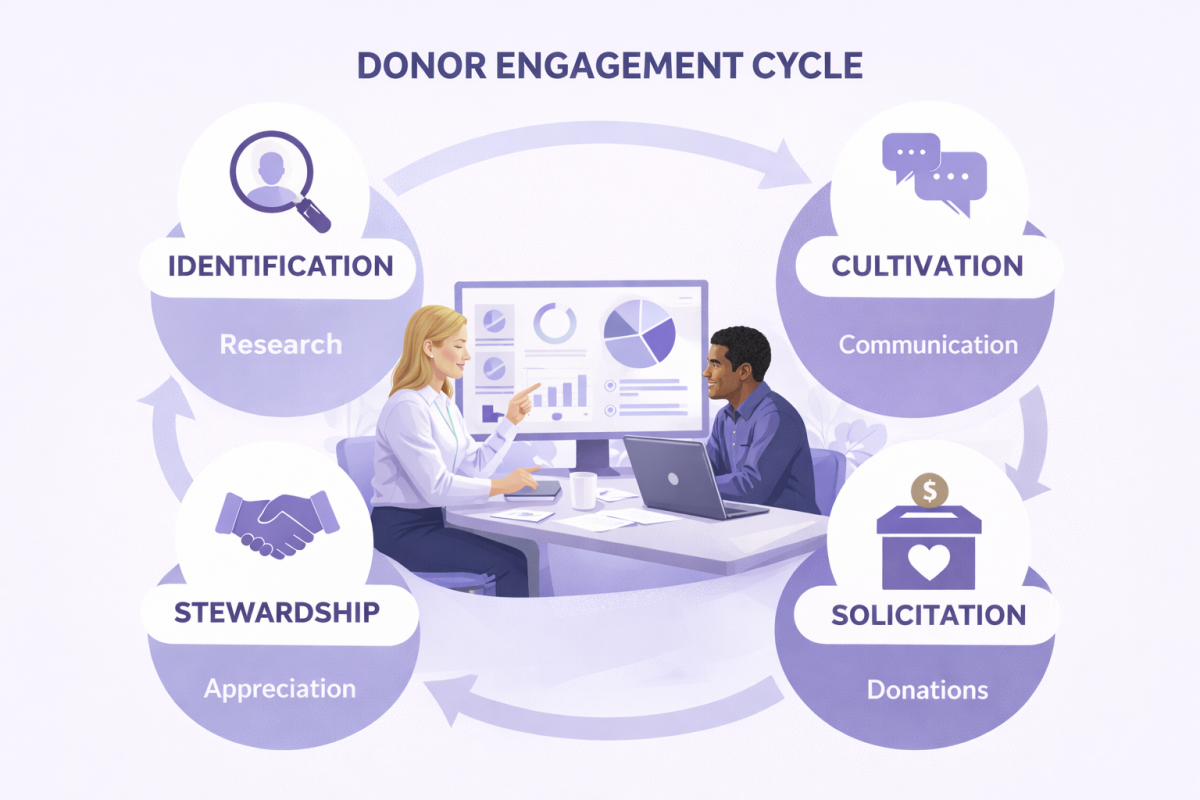
- Identification: Start by selecting ideal prospects, like choosing the right seeds. The most promising donors naturally align with your organization’s values and mission.
- Cultivation: Then nurture relationships through personalized communication, impact updates, and meaningful interactions – similar to providing essential nutrients for growth.
- Solicitation: When the relationship matures, make your ask. A well-timed request feels natural and appropriate, like harvesting at peak ripeness.
- Stewardship: Continue nurturing the relationship through regular appreciation, updates, and engagement, ensuring sustained support over time.
Donor engagement cycle: Quick action table
| Stage | Key goals | What to watch | Next steps | KPIs |
|---|---|---|---|---|
| Identification | Find mission-aligned supporters | |||
| Cultivation | Develop meaningful connections | |||
| Solicitation | Request support at the right moment | |||
| Stewardship | Maintain lasting relationships |
Why does a donor engagement strategy matter?
Building trust through transparency and impact reporting is crucial for sustained donor engagement. Research shows that approximately 24% of donors discontinue support due to lack of clarity about how their contributions are utilized.
Each phase of engagement builds upon the previous one; overlooking any stage can compromise overall donor retention. By implementing comprehensive donor engagement software and maintaining authenticity throughout the process, you can transform first-time contributors into committed long-term partners.
How to measure donor engagement?
Evaluating donor engagement requires focusing on indicators of sustained commitment rather than isolated contributions. Key metrics reveal how effectively you’re maintaining supporter relationships:
- Donor retention rate: Measures year-over-year giving consistency. Even a modest 10% improvement in retention can significantly boost revenue without expanding your donor base.
- Donor lifetime value (DLV): Calculates expected total contributions throughout a donor’s relationship with your organization. Higher DLV indicates successful cultivation and stewardship practices.
- Event engagement: Monitor registration trends, attendance patterns, and post-event follow-up activities for fundraising events such as charity galas or golf tournaments. These events serve as crucial touchpoints in your donor engagement cycle, creating opportunities for deeper connections.
- Response to appeals: Analyze email open rates, click-through metrics, and donation conversions from digital or traditional mail campaigns to evaluate message effectiveness.
5 effective donor engagement strategies for nonprofits
While measuring engagement provides valuable insights, numbers alone don’t sustain relationships. A successful donor engagement plan requires continuous nurturing to maintain and grow support over time.
Let’s explore proven donor engagement strategies that foster lasting connections:
Personalize with purpose
Strategic segmentation forms the foundation of effective donor data management. Your communication approach should vary significantly between a potential major donor considering substantial support and someone making their first contribution.
How to apply: Leverage giving history, event participation, and volunteer involvement data to create targeted communication pathways matching each supporter’s engagement level. When donors feel valued as partners rather than funding sources, both retention and lifetime value naturally increase.
Add impact to the message
Donors invest in causes, not statistics. Clear impact demonstration strengthens donor engagement and builds organizational credibility.
How to apply: Transform generic acknowledgments into personalized impact statements, replacing “Total donations: $50,000” with specific outcomes like “Your gift provided year-long treatment for 12 children in need.”
Recognition over receipts
Moving beyond tax documentation strengthens donor relationships. Thoughtful recognition, whether through personal notes or annual report features, reinforces the significance of each contribution. Recognized donors consistently demonstrate higher retention rates.
How to apply: Acknowledge supporters through various channels while maintaining appropriate privacy levels for major donors.
Note: Studies indicate public recognition may discourage privacy-conscious donors. Include preference options for recognition to respect individual choices.
Promoting recurring giving
While single donations create immediate impact, sustained giving enables long-term change. Encourage recurring support by demonstrating the cumulative effect of regular contributions.
How to apply: Optimize donation forms with prominent monthly giving options, suggested amounts, and impact visualizations showing how regular support adds up.
Leverage technology and social media
Modern donor engagement software and social platforms are essential for maintaining consistent supporter connections.
Email automation enables timely acknowledgments and updates, while social media maintains ongoing engagement through impact stories and event coverage.
How to apply: Chance2Win integrates these essential tools – combining online donation management, event streaming capabilities, and comprehensive CRM features – to maintain strong virtual donor relationships.
5 best practices to strengthen donor relationships
Once you’ve implemented your donor engagement plan and begun building relationships, the focus shifts to retention. Statistics show that organizations retain about 83% of recurring donors compared to only 45% of one-time contributors.
When retention metrics plateau or your small-donor base begins to decline, it’s time to intensify focus on existing relationships.
Here are key strategies to maintain support and reinvigorate enthusiasm:
1. Transform personalization into partnership
Move beyond tracking giving history by involving donors in future planning. Include long-term supporters in advisory discussions, seek their input on upcoming initiatives, or collaborate on community projects.
This approach positions them as integral to your organization’s strategic direction, not just financial contributors.
2. Create meaningful in-person connections
Replace standard annual reports with comprehensive progress updates and project demonstrations. Organize facility visits, exclusive webinars with program directors, or insider tours to showcase donor impact firsthand.
These engagement opportunities deliver:
- Mission understanding: Standard updates aren’t enough for experienced donors.
- Enhanced impact: Direct experiences strengthen donor loyalty.
- Advocacy growth: Personal experiences transform donors into champions.
- Unique value: Special access distinguishes your organization.
3. Build donor community
Consider this an evolution of peer-to-peer fundraising. Rather than limiting donors to fundraising within their networks, create connection opportunities through appreciation events, exclusive roundtables, or dedicated online communities.
These interactions nurture a supportive environment where donors share insights, experiences, and develop lasting connections. When donors feel part of a community, they become deeply invested in your mission.
4. Balance email communication
Organizations should maintain email frequency at one update every two to four weeks to stay relevant without overwhelming donors. For fundraising campaigns, limit communications to meaningful progress updates.
During major campaigns or events, weekly updates work if each message delivers valuable content, such as impact reports or exclusive insights.
Pro tip: Monitor email metrics closely; rising unsubscribe rates indicate need for adjustment.
5. Leverage data for giving insights
Look beyond basic metrics. Monitor donor-specific indicators including giving patterns, gift size progression, fundraising efficiency, time between donations, event participation, and email engagement.
Combine these with demographic and behavioral segments to detect potential donor disengagement or readiness for increased involvement.
For instance, donors showing steady increases in gift size or heightened engagement after impact reports may be ready for leadership-level involvement or exclusive opportunities.
Bringing it all together with Chance2Win

Donor engagement isn’t a temporary initiative for low retention periods. It must function as an ongoing donor engagement cycle of research, personalization, relationship cultivation, and continuous optimization.
With donor retention challenges persisting and small-gift supporters declining significantly, organizations that neglect nurturing their base risk experiencing decreased funding.
Chance2Win offers a solution. From building comprehensive donor profiles and communication segmentation to managing recurring giving programs, this user-friendly donor engagement software provides the framework to implement your donor engagement plan effectively.
FAQs on increasing nonprofit donor engagement
What are the core elements of donor relations?
Donor relations fundamentally relies on stewardship, acknowledgment, recognition, and engagement. These core elements ensure proper gift management, donor appreciation, personalized communications, and deepening relationships.
How can I monitor donor engagement?
Monitor engagement through both quantitative and qualitative indicators: donation frequency, event participation, email engagement metrics, and social media interactions. CRM platforms like Salesforce, integrated with Chance2Win, automate these measurements.
What does a donor engagement specialist do?
A dedicated specialist implements effective donor engagement strategies to maintain supporter connections. They develop donor segments based on behavior patterns, coordinate appreciation events, develop targeted communications, and evaluate engagement metrics.
How do I develop a donor engagement journey?
Begin by mapping every interaction point from initial awareness through recurring giving – including advertising, events, newsletters, and individual outreach. Utilize analytics and supporter feedback to understand progression through these stages.